Taking the Cosmic Neutrino Mass Apart: Geometry vs Growth, and Robustness to the Late Universe
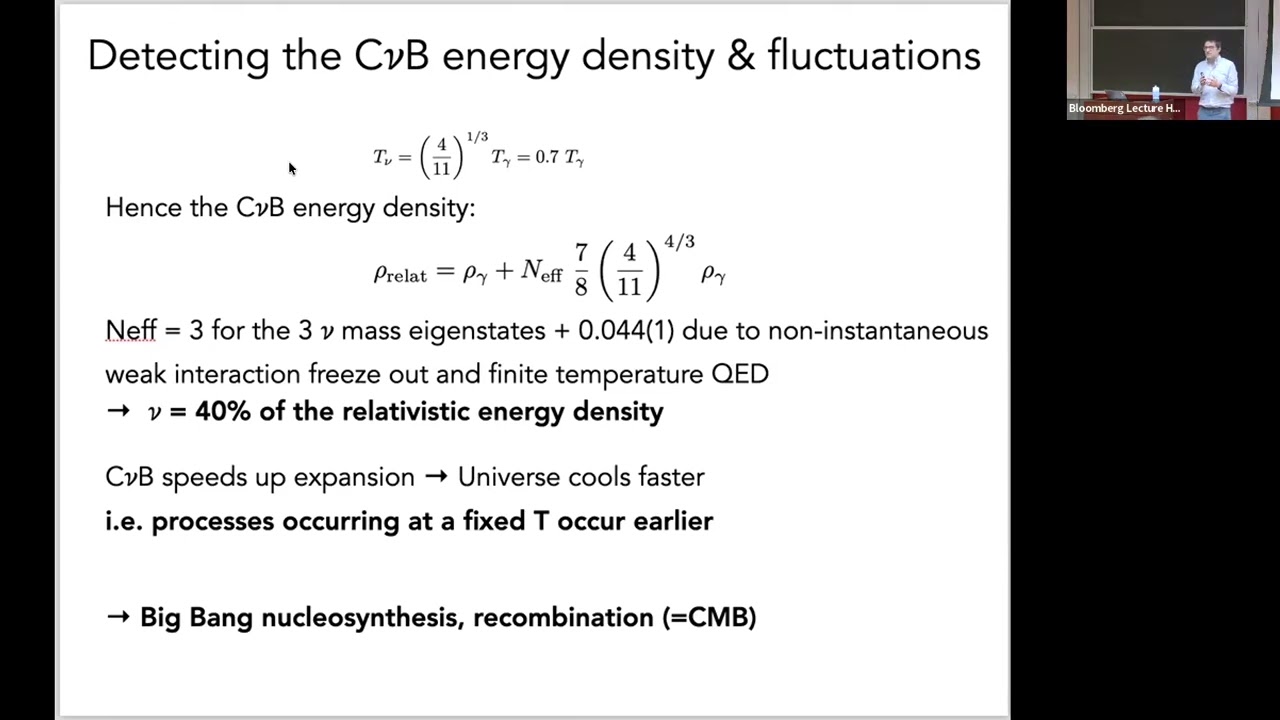
Stanford cosmologist Emmanuel Schaan presents an Institute for Advanced Study astrophysics seminar on measuring the sum of neutrino masses from cosmological data. He starts from a puzzle: Planck CMB data, ACT+Planck+SPT lensing, and DESI DR2 baryon acoustic oscillation measurements push the neutrino mass sum below 0.06 eV, the minimum value allowed by oscillation experiments, hinting at something wrong either with neutrino physics or with the dark energy assumed in the analysis. Schaan shows how to split the mass sum into two independent pieces, a geometry-only parameter and a growth-only parameter, turning the measurement into a consistency test. He argues that with upcoming Simons Observatory and DESI data, a mismatch between the two channels would point either to a misspecified dark energy model or an underestimated optical depth. He closes by testing whether neutrino mass constraints can be made independent of assumptions about dark energy, and what statistical power is lost when they are. The talk is technical, aimed at working cosmologists.