Are We There Yet? First-principles Modeling of Multimessenger Signals in the Plasma Universe
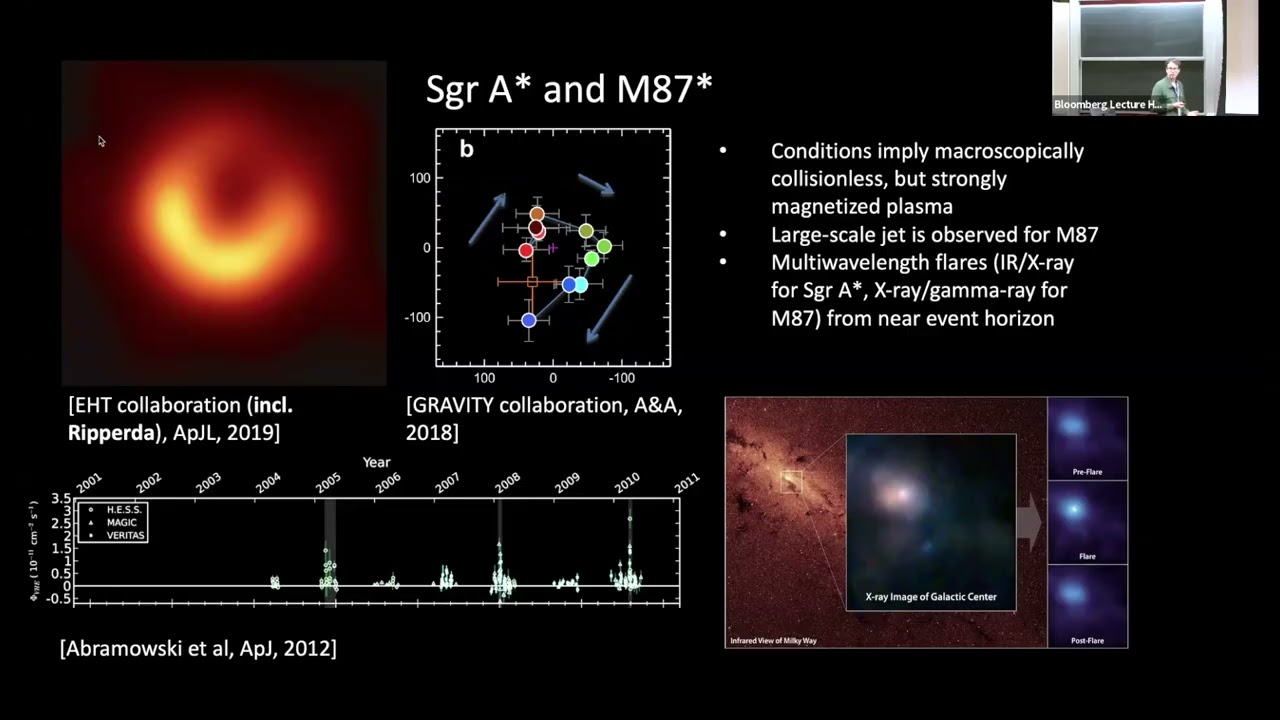
Bart Ripperda of the Canadian Institute for Theoretical Astrophysics argues that the electromagnetic and multimessenger signals from black hole accretion disks, jets, and coronae can now be modeled from first principles rather than inferred indirectly. Speaking in the IAS Astrophysics Seminar series in the Bloomberg Lecture Hall, he explains why observed radiation near event horizons shows a non-thermal, power-law electron distribution, and how magnetic reconnection and plasma turbulence tap the surrounding magnetic energy to accelerate particles. He walks through combining general relativistic kinetic particle-in-cell simulations with large-scale three-dimensional magnetohydrodynamic models to capture both global disk dynamics and small-scale kinetic processes like pair creation and annihilation. The talk covers where and how magnetic dissipation occurs around accreting black holes and what emission signatures, including neutrinos, cosmic rays, and gravitational waves, these processes should produce. It is a technical seminar aimed at researchers working on plasma astrophysics and black hole imaging.